


Auenlandbote
 Auenlandbote
Family, warhorse and Miefsittich: the Auenland Bote of 14 November
About 14 minutes to read
On 14 November, the Auenland Bote put out another edition whose first column already makes one thing clear: this is a place where people do more than report. They live, bake, prophesy and occasionally praise a horse for entirely the wrong occasion. A newsroom described as a family. An oracle in the attic of a haunted burrow. A warhorse with nowhere to put your cheese because it has no saddlebags. A concert at the Ivy Bush, a battle with serpents beneath the mountain, ruins that seemed to vanish overnight, Yule dough that nearly takes over the kitchen, and an evening of conversation postponed until December.
The full stories belong to the Bote’s writers. I am retelling the most intriguing bits in my own way, and the paths to the originals are listed at the end. We are not a partner of the Auenland Bote and earn nothing from this press review.
Hebi explains the world: this is not a newsroom, it is a family
In his not-entirely-serious opinion column, Hebiadoc Flinkfuß is not taking anyone to task this time. Instead, he introduces his own newsroom family. Read the paper and you soon realise that nobody here is merely working through a rota. They are putting up with one another, with honey cake, frying pans and a firm belief that “Nope” is often the wisest answer.
Aubi, Hebi writes, thinks too much and drinks too little. Yome wears the trousers in that household: when Aubi once wanted to set off for the Lonely Mountain, a single “Nope” was enough to keep the backpack closed and give the garden priority. At Skaldiv’s there is honey cake and a mug waiting, along with “Have you been drinking paint?” for anyone hoping for a wedding or interfering with the cake. Sebylla cooks, makes music and sets riddles; when the arguments run out, the frying pan comes out. Hebi apparently liked her riddle “You” so much that he printed it as well. Idda Goldkerze is his walking library, and Mairad supplies a line worth remembering: “Idda can even burn water!” Ijsbok remains the grumpy dwarf with a heart of gold, paying for a hungry hobbit lad’s meal. Alegrio, the maestro at the harp, keeps playing for Hebi even when the bagpipes are in the wrong key. And Beuno, “the funniest hobbit in all Middle-earth”, paints, carves and has made a rocking horse called Kleeblatt, or Cloverleaf, for Mairad’s daughter Centi. Hebi would still like to establish whether Beuno ever takes off his brown two-pointed cap. As so often with him, the investigation remains an announcement.
In the middle sits Cousin Mairad, red-haired, with red ink and a sheet of parchment that has already encountered a beer, holding the paper together. Hebi goes to Grandma Tagetes for a meal almost every day. She is ninety-seven and a cook, and tells him that if he keeps growing sideways, he will soon have to come through her door sideways too. Anyone who has read the column in Westron and still wants more will also find a version in Hebi’s own tongue. He calls the ending a Hebism: this is not a newsroom. It is one big, mad family.
A fellowship oracle in the haunted burrow
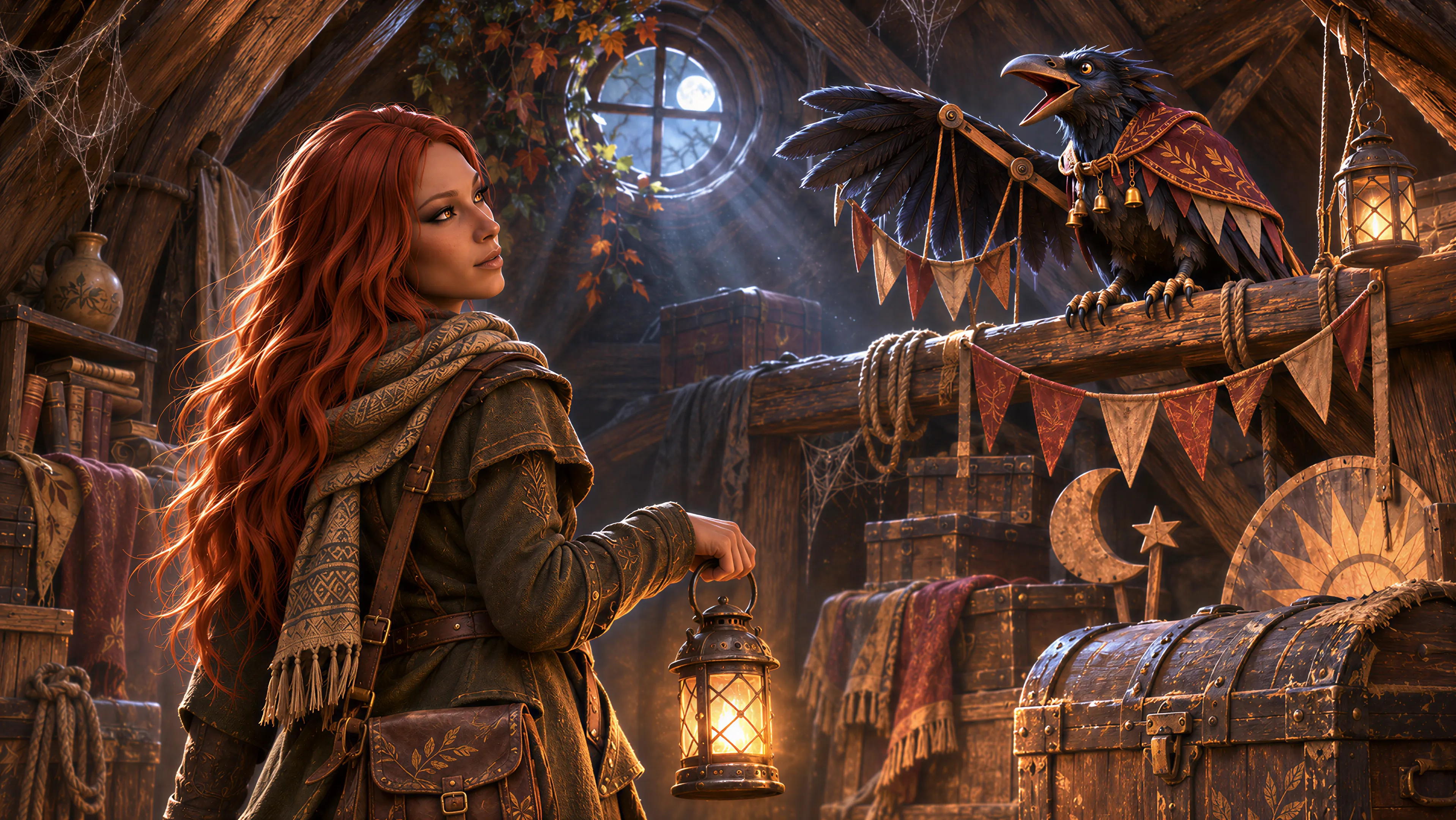
Alegrio Harfenschlag shows just how lively that family is in his account of a Harvest Festival fellowship evening at the haunted burrow on the hill. Everyone met at the Party Tree at Tulpi’s invitation, and the costumes were almost an oracle in themselves. Alegrio was still wearing his MES Jam costume from the previous day, Tulpi was dressed as the raven, Samyriah as Tulpi, and a dwarf called Torbli, Pralli’s son, appeared alongside Sarah Eichenherz speaking with Sama’s voice. Whether Torbli was really Torbol in disguise, given that Beuno kept slipping him Pewusch, remains a suspicion in Alegrio’s telling. I will leave it there too.
Tulpi sent the company into the burrow and up to the attic, where each of them was to hear their fate from the raven. Torbli later became their guide, which Alegrio politely describes as a less than ideal decision. Somehow they arrived anyway, and a voice called out from above: “CAW CAW! Come closer! Your fate is caaaaaalling! FAAAAATE!” Alegrio was promised five days of stomach ache from sea vegetables. He dismissed it at first, then writes that it came true at the next ivy gathering. The others were promised little cakes. Torbli, however, would not be able to taste his, “because you are contaminated with Pewusch”. The way out was quickly found. Afterwards, Beuno led a “circle of liberation” which, to Alegrio, felt more like a farewell circle. Less chaotic than the previous year, Beuno writes beneath the report. Mairad thought it more chaotic than frightening. As so often in the Shire, both can be true at once.
A beautiful horse for a very unwelcome occasion
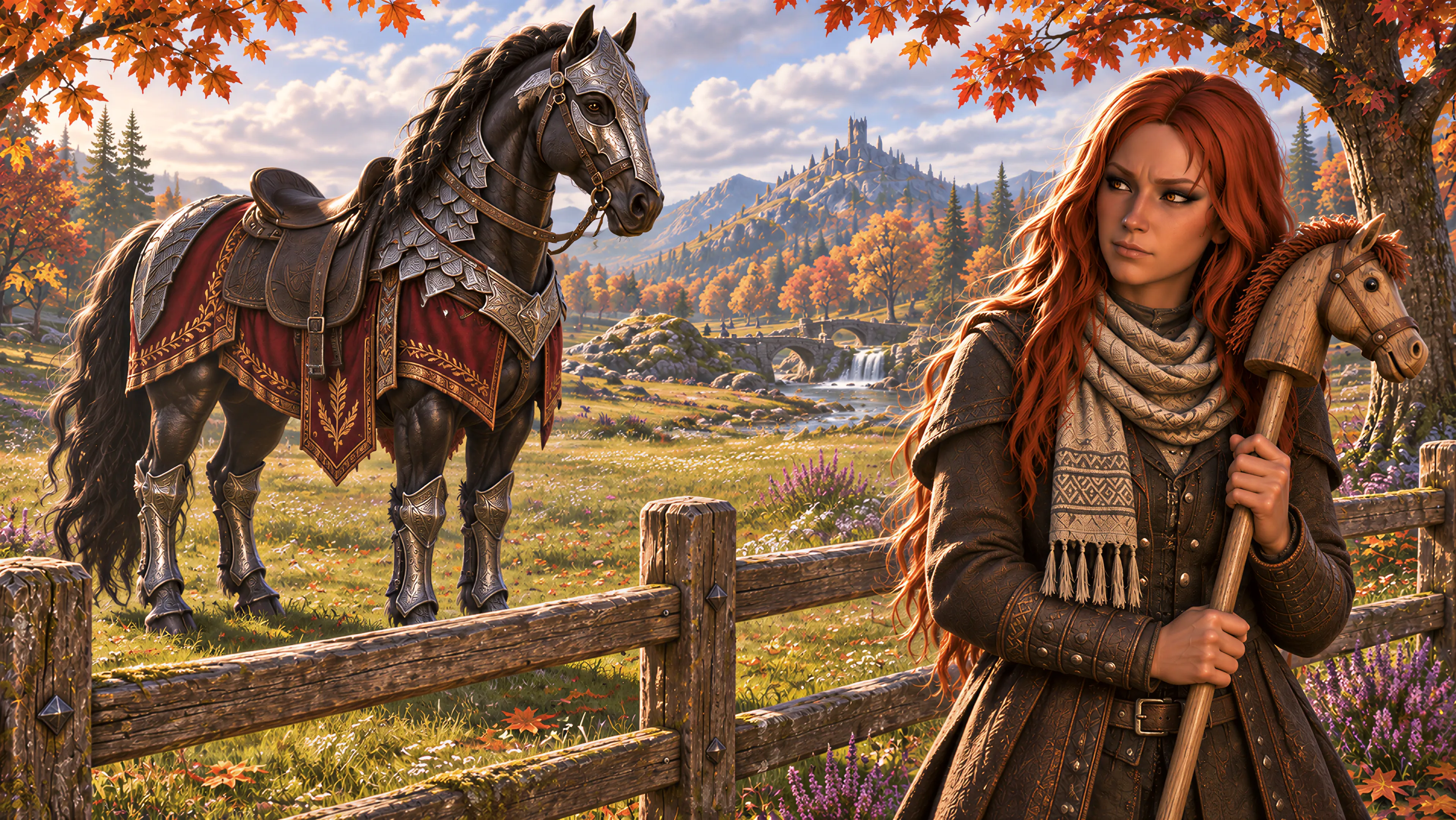
Then Mairad puts a warhorse on the table, and I instinctively move a little further away from the parchment. The animal is darkly armoured, its head silver-grey and its neck covered in overlapping plates. There is a dark saddle, a red cloth with gold patterns and leg guards that suggest a battle is about to begin. This horse is not dressed for a leisurely ride near Michel Delving, Mairad writes. It has no saddlebags for bread, apples, a blanket or cheese. It is not particularly suitable for hobbits either: difficult to mount, heavily laden and hot beneath all that armour.
I can only nod, from a very safe chair. Horses and I have a clear agreement: they stay in the meadow, I stay on the ground, and if riding is absolutely necessary, I ride my hobby horse Rosinante, which neither neighs nor wears plate armour. After the great Battle of Bywater, Mairad writes, there ought to be no more battles, and therefore no more horses dressed for one. Her verdict is: “Beauty: excellent. Strength: impressive. Suitability for a hobbit outing: moderate. Suitability for battle: sadly much too good.” She hopes the animal will soon be allowed to shed its armour in a peaceful meadow. I share that hope, without personally investigating how one would climb onto such a steed.
A darkly romantic night at the Ivy Bush on 19 November
If all that armour has left you in the mood for music instead, the Bote has something for you. Mairad reminds readers that Fortunar and Master Hamafregion, introduced in the announcement as a tea enthusiast, have already performed successfully at the Ivy Bush. According to the Bote, there will be music there again on the nineteenth day of Blotmath, 19 November 2026. The announcement gives no time. The Snouts and Beuno had apparently already found out about it. Anyone planning to attend had best pack their good spirits in good time and check locally when the first string will sound. Under the post, Sebylla asks whether the Snouts ought to be locked away beforehand. I would bring them along instead. Experience suggests they are hard to replace when there is music at the Ivy Bush.
Kriso Sturmschild tells a tale: the Hall of Stars and the Eternal Seal
On the next page, Kriso Sturmschild takes the companions back behind a sealed gate, this time under the title “The Hall of Stars and the Eternal Seal”. Eighteen companions stand there, with the army of mountain-orcs outside and a cavern whose walls shine with millions of crystals within. Dere the scholar whispers, close to tears, that they have made it. Yome immediately assesses the place’s suitability as a kitchen and starts cutting the giant chilli for a victory stew. Lillydris keeps her promise and steals nothing, polishing her daggers instead.
What follows beneath the mountain, the boats on the River of Tears, the rapids, the seal and who shares the cake at the end can all be found in Kriso’s contribution. The illustrations are by Kunobert Itzenplitz. The editors kindly note that he has captured some things very well already, while others still need practice.
Who is who: Ijsbok, the fog and a malachite tablet
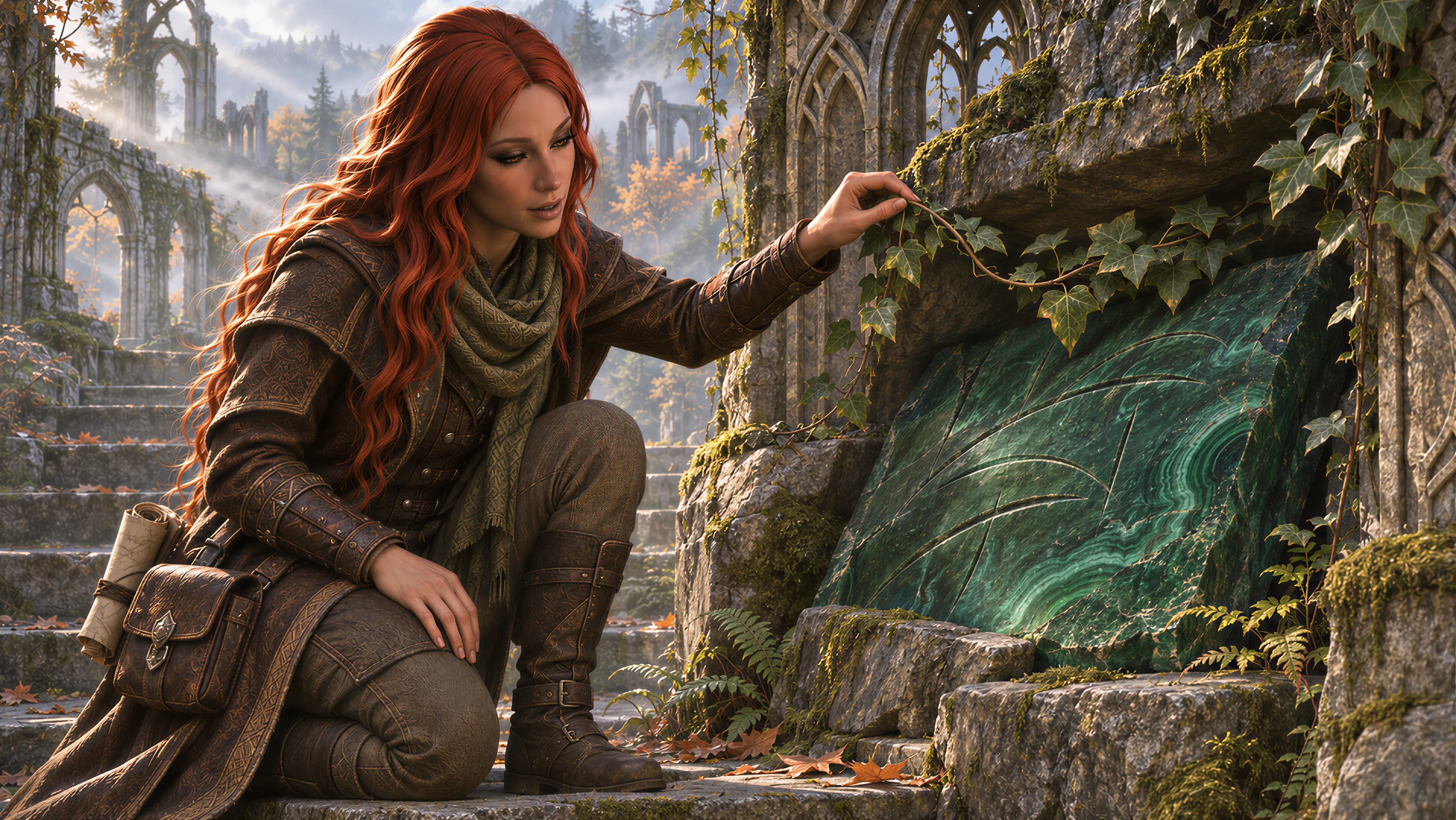
While Kriso’s story continues under the mountain, Ijsbok travels above ground in the eighth part of his story, arriving somewhat late. Sebylla Silberdistel, who writes the account for the Bote, pre-emptively threatens the grumbling dwarf with an end to Flaxia’s sausage deliveries if his punctuality carries on like this. The opening could just as easily be a bad dream. Cousin Voci wakes Ijsbok with a shout: everything is gone, the ruins, the trees, the world they knew yesterday. Ijsbok stirs the fire, hands over coffee and explains that the sky is not falling on anyone’s head. They are simply sitting in the thickest fog imaginable. Voci burns his tongue, has breakfast anyway, and when the mist lifts, the ruins are exactly where they belong.
What the two find afterwards in an alcove makes the delay worthwhile. A hefty slab of dark green malachite bears the runes of Longbeards from Belegost, called Gabilgathol in Khuzdul. In the story’s approximate translation, Aglâr, Duram, a third name only legible as Gar… and Khâl built these walls in the 498th Year of the Sun for their friend, whose name ends in …ndis and who came from the western lands. An elven dwelling built with dwarven help, and a friendship that prompts Ijsbok to reconsider much of what people thought they knew about relations between dwarves and elves. Voci draws while Ijsbok writes and maps. Two days later they move on, and after a little over a week they reach the Lhûn. The elven havens lie to the west, but the pair turn east towards the dwarven halls in the north. Sebylla would have liked to hear Voci’s side as well. She suspects Ijsbok has little interest in a search party.
Yule aromas, clouds of flour and a three-headed Miefsittich
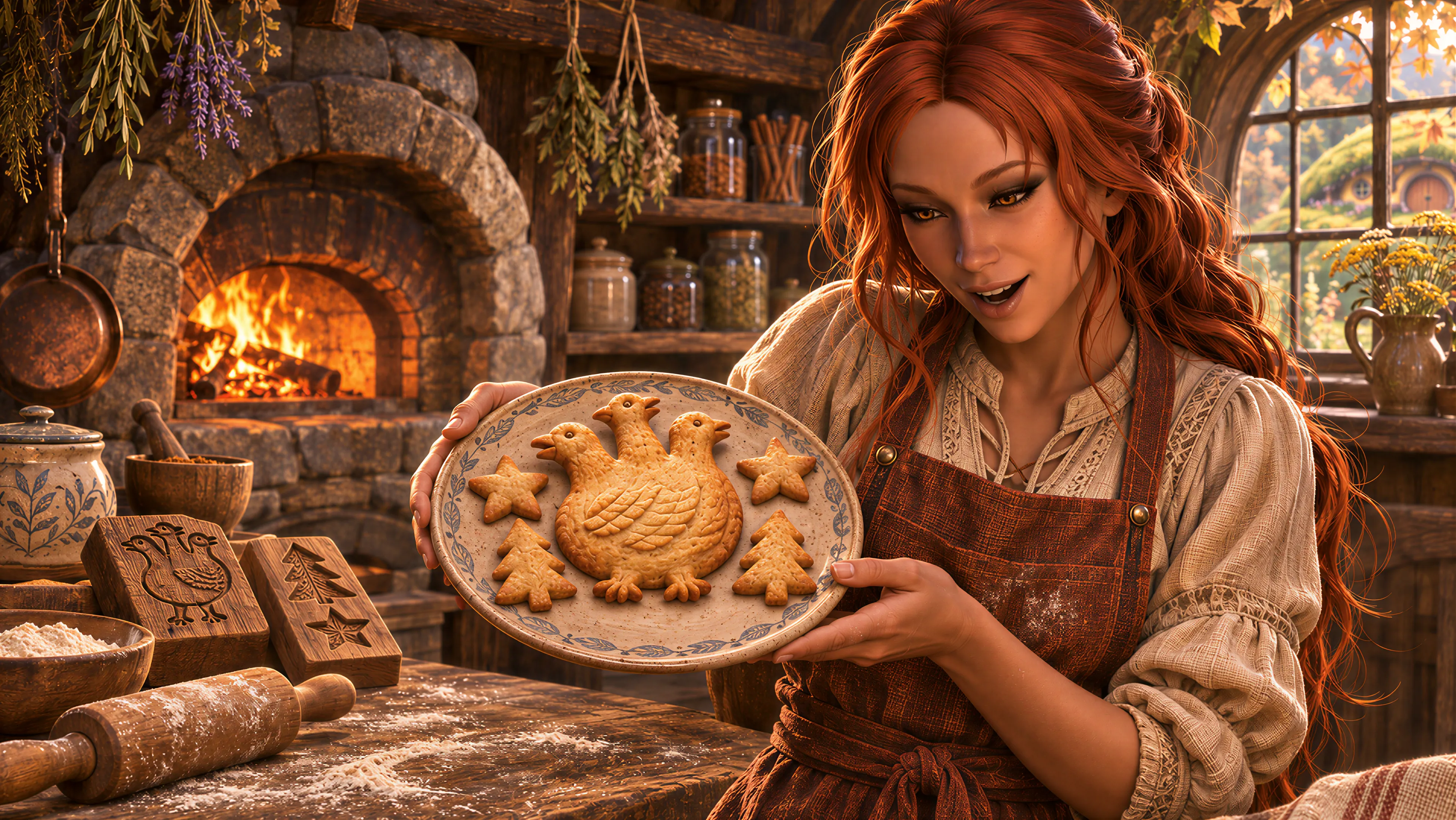
After all that antiquity, the kitchen deserves a turn, and Mairad provides one, complete with a cloud of flour. Beuno arrives at her door wearing his brown cap and carrying a basket. He wants to bake Yule biscuits with Centi, preferably in Mairad’s kitchen. He has carved the wooden moulds himself: trees, snowmen, stars and houses, plus a BoGü and a Miefsittich, the story’s fanciful bird. Centi sets her sights on an entire flock. Aubi appears uninvited, as he does wherever news, food or a minor catastrophe beckons, and explains that he wants to observe on the readers’ behalf. Mairad suspects the readers are not his first priority.
By the end, the air smells of cinnamon, cloves and cardamom, and Centi’s Miefsittich has kept all three of its heads. The recipe and the rest of the kitchen situation are in the Bote. An editorial postscript reports that, of the original fifty-three biscuits, nineteen remained at the press deadline. The three-headed Miefsittich was last seen on Aubi’s plate.
An evening with the grandmas: postponed, although mine would already have sat down
Finally, Grandma Seburga looks out from the little parlour with an awkward announcement. According to the Bote, the last conversation evening had fallen through. Only Alegrio had arrived. Grandma Tagetes had sprained her foot, Grandma Seburga writes, so the food was not ready either. The Bote says the evening has therefore been moved to Friday, 4 December 2026, without giving a time. The topic stays the same, with Saint Nicholas to be discussed as well. Was he really a southerner? Where does he put the treats when he comes to the Shire? And do dwarven boots really smell that bad? Grandma Seburga finished cooking the food from the cancelled evening and distributed it around the neighbourhood. Nothing went to waste.
Just reading this makes me think of my own grandma. Not Grandma Tagetes; let us get that straight before someone puts the two of them in the same armchair. Mine is Irmintrude Wackelwitz. She runs the Weidenteich-Zuflucht, the Willowpond refuge, with cuckoo clocks and a daily timetable that accepts no excuses, and she was not in that conversation parlour. I am only imagining her there: punctual to the minute, with a firm opinion about dwarven boots and little patience for forgotten appointments. I wish the Bote’s grandmas an evening on 4 December that fills up on time for once.
If you have read this far, you have managed to fit a family, an oracle, a horse, a concert date, a sealed rocky passage, a malachite tablet, a three-headed Miefsittich and a postponed invitation into one edition. If I were allowed to award it sweetrolls, it would get five. The Miefsittich would receive an extra one for being able to look in three directions.
Yours, Patsy Wackelwitz
Press review: the original articles in the Auenland Bote
The complete texts and pictures belong to their respective authors. Please continue reading there; the original contributions are in German:
- Hebiadoc Flinkfuß, published by Mairad Birnhaag: Hebi explains the world — the not-entirely-serious opinion column
- Alegrio Harfenschlag: A fellowship oracle in the haunted burrow
- Mairad Birnhaag: A beautiful horse for a very unwelcome occasion
- Mairad Birnhaag: Another darkly romantic night at the Ivy Bush on 19 November 2026
- Published by Mairad Birnhaag, illustrations by Kunobert Itzenplitz: Kriso Sturmschild tells a tale — the Hall of Stars and the Eternal Seal
- Sebylla Silberdistel: Who is who? — Ijsbok, part VIII
- Mairad Birnhaag: Yule aromas, clouds of flour and a three-headed Miefsittich
- Seburga Silberdistel: An evening of conversation with the grandmas
The current edition of the Auenland Bote
Patsy Wackelwitz is a fictional character. This article was created with AI assistance. Our images are freely imagined AI illustrations inspired by this press review; they are not game screenshots or original pictures from the Auenland Bote.
More stories worth a read

Patsy reads the Auenland Bote: a Zoing fee, soulful tea time and a wizard who preferred his pipe
Press review of 31 October 2026 — written by Patsy Wackelwitz for the Rabenpost My dear butterfolk, Every two weeks, at six in the evening sharp, a fresh Auenland Bote lands on …
Read more : Patsy reads the Auenland Bote: a Zoing fee, soulful tea time and a wizard who preferred his pipe
Patsy reads the Auenlandbote: tea, a sense of rhythm and a very long coat
Press review · 24 October 2026. My dear butterfolk, I have been browsing the Auenland Bote. A dangerous occupation: you only mean to read a little, and suddenly you have a concert …
Read more : Patsy reads the Auenlandbote: tea, a sense of rhythm and a very long coat
Aymy and the Blueberry Snouts: 173 musicians and a Mupf piggy bank
People & Places – by Patsy Wackelwitz · Deutsche Fassung There are people in life you really ought to meet. And then there are the ones you meet whether you planned to …
Read more : Aymy and the Blueberry Snouts: 173 musicians and a Mupf piggy bank